
How to set quarterly goals when yearly ones never stick
Ziyaan Virji · April 1, 2025
I used to hate setting goals.
Every January I would write a list, feel good about it for two weeks, and then let life take over until December, when I would find the list again and feel bad. The cycle repeated for years. The goals were never the problem. The gap between setting them and looking at them again was.
Then I came across a way of planning in three month blocks, and it changed how I operate. Not because the goals got smarter, but because I started catching myself drifting while there was still time to do something about it.
Here is the picture that made it click. A plane leaving Toronto for London is off course most of the flight. The pilot is not making one perfect decision at takeoff, they are making thousands of tiny corrections along the way. Shift the heading by one degree and hold it, and you land somewhere else entirely. Annual goals give you one correction a year. Quarterly goals give you four.
This is the process I run every three months. It takes about three hours. A lot of it is adapted from Sahil Bloom, whose annual planning work is where I first found the reflection and scoring idea.
Step 1: Score the quarter that just ended
Give this one or two hours. Open a notebook or a blank doc.
Start by dividing your life into the areas that actually matter to you. Mine are work, health, relationships, and social. If you are a student you might add school, or learning, or a specific extracurricular. Four to six is the right number. Fewer and it is too vague to act on, more and you will not keep up with it.
For each area, answer three things.
Wins. What went well? What are you proud of? Where did you make real progress, even if it was small?
Lessons. What did not go the way you planned? What felt off? Which habits or decisions would you change if you got the three months back?
Score. Rate your satisfaction with that area out of ten. Rate it against where you started and where you want to be, not against anyone else. A six that used to be a three is a good quarter.
Be specific in the wins and lessons. "Health was bad" tells you nothing. "Went to the gym three times a week for the first six weeks, then stopped when midterms started, and ordered takeout about three times a week after that" tells you exactly what to fix.
Step 2: Write down what you actually want
Take another twenty minutes and let yourself think past the quarter.
Write everything you would want to do if time, money, fear, and experience were not in the way. Do not filter it. The prompt I use: what would the version of me who believed anything was possible put on this list?
You will not act on most of it this quarter. That is fine. The list is there to point the next three months in a direction, so you are not just optimising a life you never chose.
Step 3: Set one outcome goal per area, then the process behind it
This is the step I got wrong for years, and it is the one that matters most.
Take each area and set a target score for the coming quarter. Health six to seven. School seven to eight. Small moves. A jump from four to nine in three months is a fantasy, and fantasies are demoralising by week three.
Then set one outcome goal per area. One. I used to set five per area and miss all of them, which felt worse than setting none. An outcome goal is the result: raise this much, finish this project, run this distance.
Then, and this is the part people skip, set one to three process goals for each outcome. Process goals are the repeated actions that would make the outcome happen almost automatically.
Say the outcome is growing something you are building. The process goals might be three hundred outreach emails a week, one piece published every week, and a fixed number of posts. If you do those consistently for twelve weeks, the outcome mostly takes care of itself.
The difference matters because you do not control outcomes. You control what you do on a Tuesday. Track the Tuesdays.
Step 4: Decide how you will measure it
For each area, write down how you will know whether the process goals are happening. Keep these embarrassingly simple.
Health: gym three times a week, seven and a half hours of sleep. Social: one real conversation a week, two group things a month. Work: a weekly planning session, one project shipped by the end of the quarter.
If a measure needs a spreadsheet to calculate, it is too complicated and you will stop checking it.
Step 5: Check the numbers against the hours you actually have
Here is where most plans fall apart. The goals are reasonable on their own and impossible together, because nobody checked them against the calendar.
You have 168 hours a week. Take out seven and a half hours of sleep a night and you are left with about 115 waking hours. That is the real budget. Everything you have just committed to has to fit inside it.
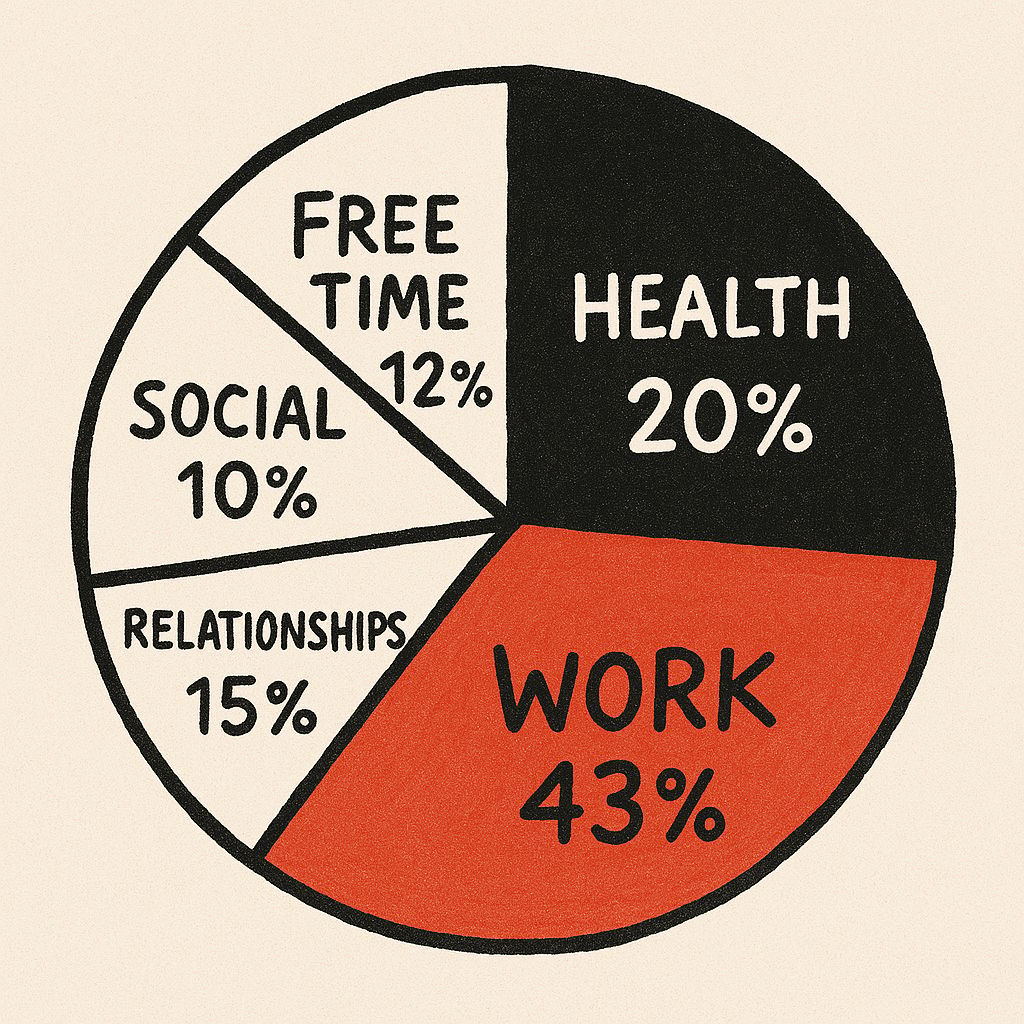
Assign hours to each area based on your process goals. Mine tends to land near work at 43 percent, health at 20, relationships at 15, free time at 12, and social at 10. Yours will look different, and it should.
Then subtract the non-negotiables that are already fixed. Classes, commute, a standing family commitment. What is left is the part you are actually deciding about, and it is always smaller than it feels.
Seeing time laid out this way is what made saying no easier for me. My worst habit was overpromising, and it came from consistently overestimating how much room I had. When the hours are written down, a new commitment stops being free.
Step 6: Give it to someone else
None of this survives contact with a busy month unless someone is checking.
Find one person, a friend, a sibling, someone building something of their own, and book a recurring call. Once a week if you can, once a month at minimum. Go through the scores, what moved, what did not, and what changes.
The value is not accountability in a disciplinarian sense. It is that saying "I did not do the thing" out loud to someone makes you notice a pattern three weeks in rather than three months in.
If it helps, colour code your calendar by area so you can see the split at a glance. When one colour is quietly eating everything, you will spot it.
What this actually gives you
Not perfection. I have run this process for years and still have quarters I would rather not talk about.
What it gives you is four chances a year to notice you are off course, instead of one. Most of the difference between people who get where they meant to go and people who do not is not talent or discipline. It is the length of the feedback loop.
Once your goals are set, the next problem is fitting them into a week that is already full. That is a separate skill, and I wrote about how I handle it in how to manage your time as a student.
Three hours, four times a year. Start with the quarter you are in.
Frequently asked questions
- How often should I set goals?
- Every three months. Annual goals are too far away to correct when you drift, and weekly goals are too short to show real progress. A quarter is long enough to finish something and short enough that a bad start does not cost you the year.
- What is the difference between an outcome goal and a process goal?
- An outcome goal is the result you want, like saving two thousand dollars. A process goal is the repeated action that produces it, like transferring a set amount every payday. You control process goals directly, which is why they are the ones worth tracking.
- How long does quarterly planning take?
- Around three hours in total. Roughly one to two hours reflecting on the quarter that just ended, and another hour planning the next one. Doing it in one sitting works better than spreading it out.
- What if I miss a quarter?
- Start with the current one. The point of the cycle is that a missed quarter costs you three months rather than twelve. There is no penalty for restarting, and the reflection step works just as well on a quarter you feel bad about.
- Do I need an app or a template for this?
- No. A notebook or a blank document is enough. Every step here is a list or a small table you can draw yourself, and building it by hand tends to make you think harder about the categories than filling in someone else's.