
How to manage your time as a student when you are involved in too much
Ziyaan Virji · January 30, 2024
I started a nonprofit in grade nine, and from that point on I was always behind on something.
It felt like I was involved in a lot of things and doing none of them properly. There was always someone to disappoint, a teacher, a friend, or my own team. I told myself that was just the cost of caring about more than one thing.
It caught up with me in 2021, when I moved to Canada for university. I stopped getting out of bed. I skipped most of my classes, went out a lot to avoid thinking about it, and told nobody. That went on for months.
Then I failed a course. ECON 102, first year, a 48.

I thought I was going to lose my scholarship. That was the moment it stopped being a rough patch and became a thing I had to actually solve.
What follows is what I built after that. I would not call it figured out. It is three steps that have held up for a few years now, and they work in that order for a reason.
One caveat before we start. This works for me. Treat it as a starting template, not a prescription, and change whatever does not fit your life.
Step 1: Stop trying to be balanced
I have come to dislike the word balance. Look up the definition and it is about distributing weight evenly so something stays upright.
Applied to a life, that means giving roughly equal time to everything you are involved in. Which sounds fair, and produces a predictable result: average time in five places gets you average outcomes in five places.
Almost nobody actually wants that. What people want is to do one or two things genuinely well while not letting the rest collapse. That is not balance, it is deliberate imbalance, and it works much better once you say it out loud.
So instead of splitting yourself evenly, decide the split on purpose.
Picture your week as one large bucket of water, and the parts of your life as smaller buckets. You are pouring a fixed amount. Every bit that goes into one is not going into another. There is no arrangement where they all fill up.
Write down your life areas for this stage of your life, not the stage you wish you were in, and assign each a percentage. Mine at the time looked like this.

Work at 45 percent. Health at 20. School at 16. Social at 9. Everything else at 10.
Notice that school is not the biggest number for someone who is a student. That was a real decision with real consequences, made knowingly. Yours might be the opposite. The point is that you chose it rather than discovering it in April.
Two things help when you are picking numbers. Separate needs from wants honestly. And accept that the numbers will look wrong to somebody, which is fine, because they are not living your term.
Step 2: Budget your time like money
Percentages are theory. Hours are real.
I got this framing from Sahil Bloom's piece on being a time billionaire. The idea is that we are fascinated by people with a billion dollars and completely uninterested in the fact that someone in their twenties has roughly two billion seconds left. Time is the asset. We just do not account for it like one.
So account for it like one.
You have 168 hours a week. Seven and a half hours of sleep a night takes 52.5 of them. That leaves about 115 waking hours in your account.
Now subtract the things that are already fixed and non-negotiable. For me that was roughly:
- Workouts, an hour and a half, three times a week
- Classes, four courses at three hours each
- A night routine, an hour, five nights a week
- Mosque, four hours including commute, once a week
That is around 25 hours gone before I have decided anything. Which leaves about 90 hours to distribute across the percentages from step one.
Do this once and the arithmetic starts making decisions for you. My worst habit for years was overpromising and underdelivering, and it came from a simple error: I consistently believed I had more time than I had. When the hours are written down, a new commitment is visibly taking something from somewhere else. Saying no gets much easier when you can see what yes costs.
Step 3: Block the calendar
Priorities and a budget do nothing until they hit a specific hour on a specific day.
Every night, as part of my night routine, I plan the next day in my calendar. It takes about ten minutes and it means I wake up without having to decide anything.
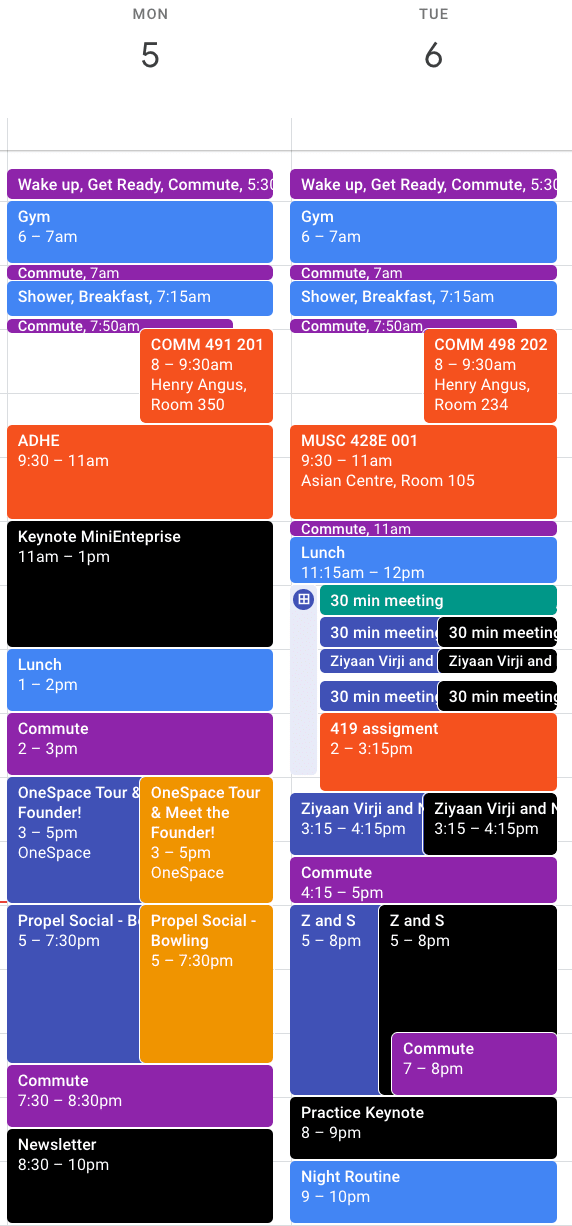
Ten principles I follow when I build it:
- Wake at 5:30, sleep at 10. Seven and a half hours, held as close to daily as I can manage.
- Colour code by life area, so a glance tells me if one colour is eating the week.
- Keep classes clustered rather than scattered across every day.
- Use a booking link so scheduling does not become its own inbox.
- No meetings before noon. Mornings are for the work that needs a working brain.
- Meetings only on two days, back to back, so the other days stay whole.
- Split the week into making days and maintaining days, and do not mix them.
- Night routine at least five times a week.
- Coffee chats on one day only, fifteen minutes each.
- Default to virtual. If it could be an email, make it an email. If an invitation is not a clear yes, it is a no.
That last one does most of the work.
What actually happens
I would be lying if I said I do this every day. I do not. These are systems built for an ideal week, and plenty of weeks are not ideal. I miss the wake up time, I let meetings sprawl, I skip the night routine.
The systems still help, because on a bad week I am falling back to a structure instead of to nothing.
Two things I hold on to. If you have 30 percent to give today and you give 30 percent, you gave everything you had. And the currency here is progress, not perfection. One percent better, repeatedly, compounds further than any single heroic week.
If you have not decided what you are aiming at yet, the hours will not help much. That part comes first, and I wrote about it in how to set quarterly goals.
Start with step one. Write your areas down and put a number next to each. It takes ten minutes and it is the step everything else rests on.
Frequently asked questions
- How many usable hours does a student actually have in a week?
- About 115. There are 168 hours in a week, and seven and a half hours of sleep a night uses roughly 52 of them. Everything you are committed to has to fit inside what remains, which is far less room than most schedules assume.
- Is work life balance realistic for students?
- Not in the sense the word suggests. Balance implies giving equal weight to everything, and equal time across five commitments tends to produce mediocre results in all five. Deliberate imbalance, revisited each term, is more honest and more effective.
- What should I do when I am already burnt out?
- Cut commitments before you try to optimise the ones you have. Time management systems assume you have a workable amount to manage. If you are missing classes and struggling to get out of bed, the problem is load, not scheduling, and no calendar will fix it.
- How far ahead should I plan my day?
- The night before. Planning tomorrow at the end of today takes about ten minutes and means you start the morning without deciding anything. Planning a whole week in detail rarely survives past Tuesday.
- Does this system work if my schedule changes every week?
- Yes, because the percentages stay fixed while the specific blocks move. You are deciding how much of your week each area deserves, not committing to the same hours every Monday. Rebuild the blocks weekly around whatever is fixed.