
Immigration & Refugees
One email address between a refugee and a scholarship
Milly Nakkungu has spent more than two years helping refugee girls and young people in Kyaka II Refugee Settlement reach opportunities, including more than 50 who needed email addresses to register for an online entrepreneurship training.
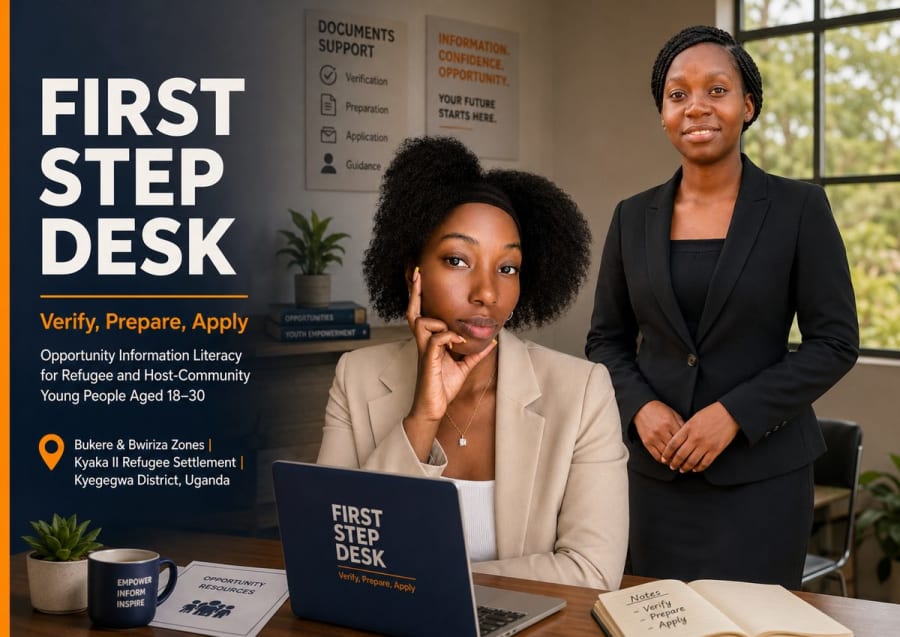
No email address. No CV. No scanned documents, no internet, nobody to sit beside you while you complete an online form. Milly Nakkungu says she has watched bright young people in Kyaka II Refugee Settlement, Uganda, miss a scholarship, job or training place for exactly those reasons. "I started helping with my phone and borrowed devices whenever I could," she says.
She has just graduated from Nkumba University, Luweero Campus, in Public Administration and Management, and has been doing this work for more than two years.
“A scholarship, job or training should not be lost simply because someone lacks one first step. Sometimes all a young person needs is someone to help them create an email, prepare a CV, scan a document or complete an online application. I want First Step Desk to be that first step.”
Milly Nakkungu
Two girls she helped search for scholarships are now studying. A third, whom she helped prepare and submit a job application outside the settlement, now works outside the camp. When Junior Achievement Uganda ran an online entrepreneurship training for youth aged 18 to 30, more than 50 refugee boys and girls needed email addresses and online registration to take part. She helped them register.
First Step Desk is what she is building next: a small desk in Bukere A, Bukere Zone, in Kyaka II. A refugee elder has offered her space at his home, so there will be no rent. She plans a refurbished laptop, a printer and scanner, a 5G router, and a removable sign she will put out each morning.
Core support will stay free for those who cannot afford to pay. To keep the internet, paper and ink running, she plans to charge other community users UGX 1,000 for a Wi-Fi session, UGX 500 for printing and UGX 200 for photocopying. Each person will own their own email address and password, she says, and she will not keep passwords or use people's documents without their knowledge.
"I want the desk to be known as a place where people are helped, not judged," she says. "A young person who has never used email should not feel embarrassed."
She is not trying to create a big office. "I am not starting from zero," she says. "I have already seen how one completed form can change someone’s direction."