
Environment and Climate
Turning field notes into floor votes in Hawaiʻi
Jenavive Meays leads Corals to Committees, a youth initiative in Hawaiʻi that pairs shoreline workdays and a grassroots podcast with training young people to testify on the bills that govern their own homes.
Three Senate bills, broken down for young people. SB 3014, on protections for native honu. SB 3253, establishing a Hawaiʻi Conservation Sanctuary. SB 1262, protecting herbivore reef fish like Kala and Uhu. That is the work of the Oceans & Biodiversity Working Group, which Jenavive Meays runs with her team, affiliated with the Climate Future Forum and the Jane Goodall Institute. Over the last year, she says, they have "been fighting to get young people involved in local policy."
That policy work laid the foundation for Corals to Committees, the initiative she now leads. The problem it goes after is a disconnect in Hawaiʻi, "the gap between environmental science and the everyday people who actually rely on our ecosystems," she says. Dense scientific jargon and the physical ocean between the islands, she says, "consistently lock marginalized, rural communities out of the legislative process." The project is about translating "field notes into floor votes," so young people from mauka to makai, mountain to sea, can understand policy and advocate for where they live.
“You do not need a PhD to be a scientist; you do not need to be senator to change policy”
Jenavive Meays
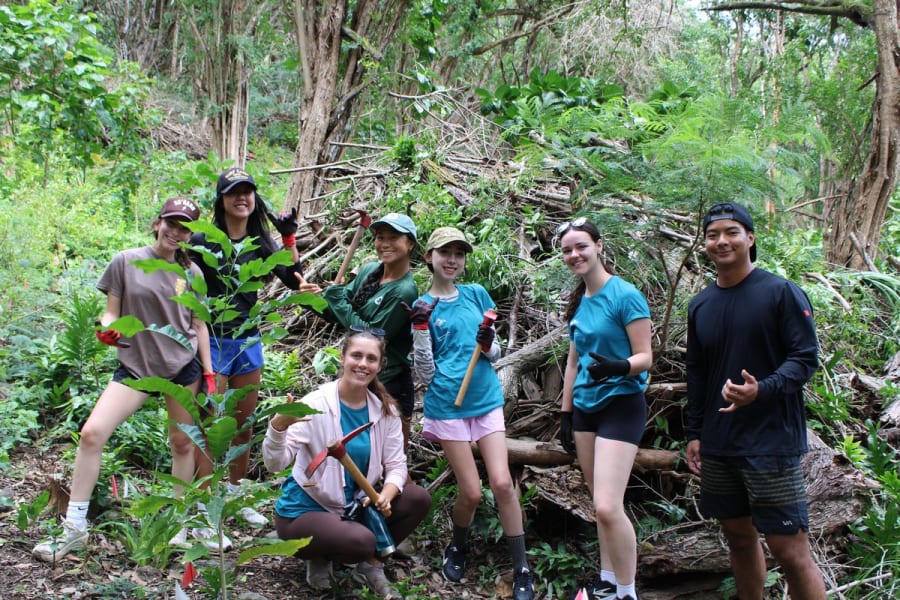
She describes the plan in three phases. First come the field days, pulling invasive limu at Paiko Bay and doing watershed restoration at Kuli‘ou‘ou Ridge, with a first major Field Day planned for July 31st. Alongside the physical labour, the team is recording a grassroots podcast, interviewing local fishermen, scientists, and community leaders and putting the dense science into plain language. Second is the Climate Future Forum Youth Summit this fall, where they bring that audio and the legislative literacy kits they are building to the State Capitol, and use the podcast to train students to argue for structural changes. Third, meetings with lawmakers.
The reason is close to home. "Growing up on Maui, the 2023 wildfires made it painfully clear that we shouldn't have to wait for an absolute tragedy to unite us," she says. "We need proactive, accessible civic engagement, and isolation should not be the excuse for inaction."
What she wants lawmakers to see is a generation ready to work. "We are educated, organized, and actively doing physical labor to protect our ecosystems," she says.