
If you want to help someone, listen first
Ziyaan Virji · February 4, 2025
Have you ever tried to help someone and realised later you might have made things worse?
That is what happened with my first project, and it took me a year to see it.
A documentary and a phone call
At school I had to complete a personal project, a long assignment where you could take on any issue you cared about.
Around that time I watched a documentary about a social entrepreneur in India who had built an affordable menstrual product for women without access to one. Growing up in Tanzania, in an Indian Muslim household, periods were not something we discussed. But the documentary stayed with me, so I did the only sensible thing available to a fifteen year old boy who wanted to understand something.
I called my mum.
She told me that when she was younger she had not had access to menstrual products either. She had used old rags and cloths, and something that should have been ordinary had been made shameful instead.
That was the point it stopped being a documentary.
The iPad, and I am sorry
I designed a reusable pad. In a display of fifteen year old marketing instinct, I named it the iPad.
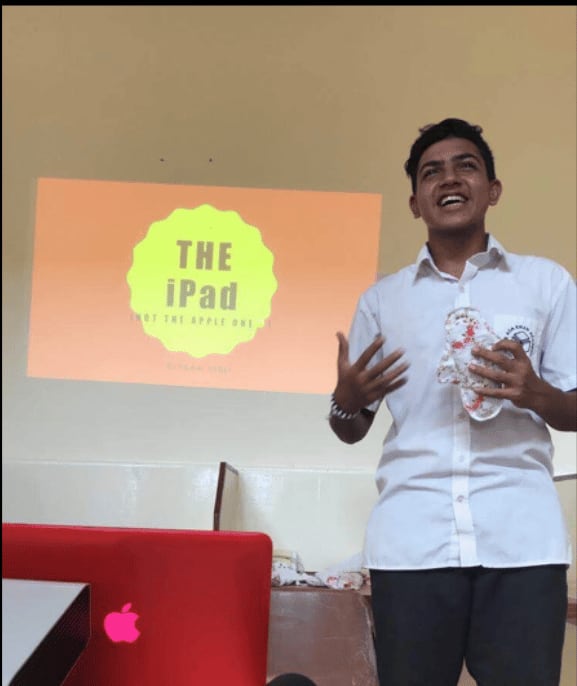
I put a picture of myself beside Steve Jobs in the presentation, as though I were launching a product at a keynote.
The absurd part is that it worked. I found a local tailor, we made the product together, and we distributed it to twenty two menstruators in a nearby community.
I thought I had disrupted something. I thought I was a changemaker. I thought the problem was solved.
What I found a year later
The product lasted about six months.
Which meant that six months after we handed it out, the same twenty two people needed help again. I had not built independence. I had built a recurring need, with myself in the middle of it, and I had spent a year feeling good about it.
That is the part worth sitting with. It did not feel like a mistake at any point. It felt like success. There was a product, there were beneficiaries, there was a number I could say out loud.
I had gone straight into fixing without once asking the people I was trying to help what they actually needed. The phrase for this that finally landed with me came from Ernesto Sirolli's TED talk, which is worth the seventeen minutes.
So I went back and asked.
What they actually said
Not products. Or not only products.
They needed education, because a product does not help if the shame around using it is untouched. They needed access to proper hygiene facilities. And they needed something that did not expire in six months and leave them where they started.
So we changed what we were doing.
Instead of distributing pads, we worked with women with disabilities who could stitch reusable pads themselves. We taught communities how to make them, so the supply did not depend on us showing up. We moved from giving things to people to putting the capability in their hands.
That is when it started working, and it is also when it stopped being a story about me.
How often we all do this
I notice this everywhere now, including in myself.
Founders build products without talking to the people who would use them. Organisations launch programmes for communities they never consulted. And in ordinary life we offer advice to a friend who wanted to be listened to, which is the same error at a smaller scale.
The pattern is always the same. We identify a real problem, then move straight to a solution, because solving feels productive and asking feels slow. Asking is not slow. It is the part that determines whether the rest of the work counts for anything.
Three questions worth asking this week
If you are building something, leading something, or trying to support someone, stop at these.
Am I solving a problem, or am I assuming one? These are indistinguishable from the inside until you check.
Have I actually asked the people this is for, before building rather than after? Feedback on a finished thing is not the same information.
Am I creating independence, or a dependency I have not noticed? The test is what happens if you disappear.
I got a year of feeling like I had done something good, on the basis of a number that did not mean what I thought it meant. The pivot only happened because I eventually asked a question I could have asked at the start.
If you are at the point of starting something rather than fixing it, how to actually take the first step is the more useful place to begin.
Ask first. It costs a conversation and it saves a year.
Frequently asked questions
- What is the most common mistake in youth-led social impact projects?
- Designing the solution before talking to the people it is for. It is easy to identify a real problem, build something reasonable, and never check whether it addresses what those affected would have prioritised themselves.
- What is the difference between helping and creating dependency?
- Whether the people involved are better able to solve the problem without you afterwards. Handing out a product that needs replacing creates a recurring need. Teaching people to make it themselves removes you from the loop, which is the point.
- How do I know if my project is actually needed?
- Ask people directly what would help most, before you have anything to show them, and be prepared to hear something that makes your idea unnecessary. If you only ask once you have built something, you will hear feedback on your solution rather than the truth about the problem.
- Is it bad to start a project without expertise?
- No. Starting without expertise is normal and often the only option. The failure is not inexperience, it is not asking, and asking is available to anyone regardless of what they know.
- How do you recover from getting a project wrong?
- Go back and ask the questions you skipped, then change the design around the answers. That is what turned mine around. The initial mistake cost a year and did not have to be permanent.