
How to follow up after a coffee chat
Ziyaan Virji · March 18, 2024
I'm Ziyaan Virji. I run Leaders of Today, a platform that helps young people find opportunities, and a big part of my job is meeting people: executives, funders, founders, students.
Which makes it slightly embarrassing that one of my biggest weaknesses, and something I've been working on for a couple of years now, is relationship management.
For the longest time I was that guy who wouldn't reply to your texts for weeks and would only reach out when it was urgent or when I needed something.
I became more aware of it in 2022, when the habit started showing up in my professional relationships. I realised I was very good at having initial coffee chats and very bad at converting them into anything long term.
Looking back, I've had chats with CEOs, members of parliament, celebrities, sports legends, even a billionaire. None of those mean anything now.
I used to think networking was about having conversations with as many established people as possible. I was playing the game wrong the entire time. Networking isn't about the number of people you know, it's about the depth of the relationships you have.
Here are the five steps I use after meeting someone, plus the relationship tracker I keep.
Step 1: The follow-up email
Within 24 to 48 hours of meeting someone, send a follow-up message. As simple as that sounds, most people get this part wrong.
Instead of a basic thank you note, use the message to add value to the person you met.
"But Ziyaan, I'm only a student. How can I add value to someone more experienced than me?"
It doesn't have to be big or complicated. Here's a real example.
I met with Zabeen Hirji, former Chief Human Resources Officer at RBC, Canada's largest bank. During our 30 minute conversation I spent the time learning about her story, her interests, her goals, and her challenges. Then I sent this.
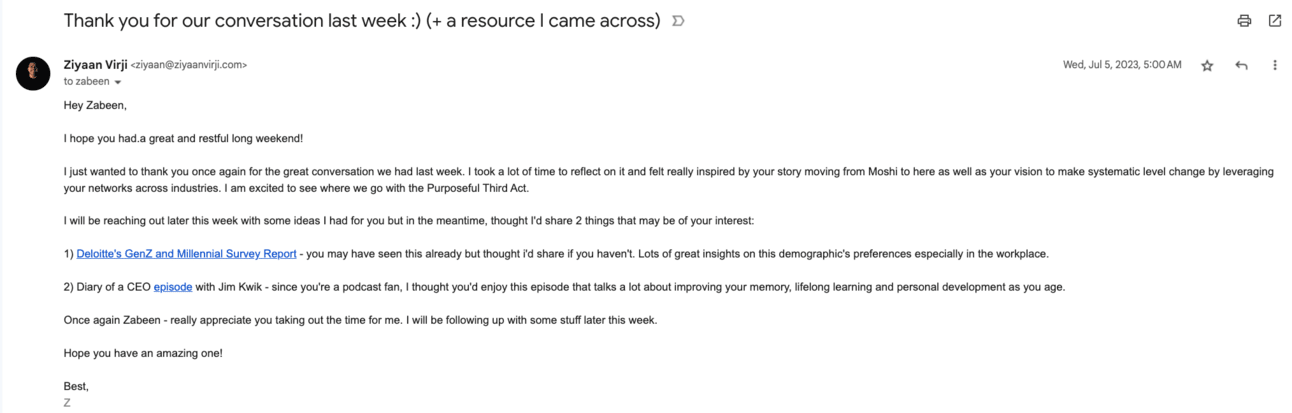
Four things are doing the work there.
The subject line. "Thank you for our conversation last week :) (+ a resource I came across)". I didn't overcomplicate it, and it tells her exactly what's inside.
A personalised thank you. After thanking her, I named something specific I took away from the conversation, including the story she told me about moving from Moshi and her new initiative, Purposeful Third Act. This matters because it shows the conversation landed and that there was a real takeaway.
Value. Zabeen mentioned she listens to a lot of podcasts and is interested in the future of work. I had nothing significant to offer, so I spent fifteen minutes finding two things she'd probably like, Deloitte's Gen Z and Millennial Survey and a Diary of a CEO episode with Jim Kwik, and sent them over. Notice that I said why I was sending each one, so she didn't have to dig to find out.
No ask. Zabeen is one of the most connected people I know. I could have had an endless list of asks that would have been life-changing for me. I had none. If you want to network properly, build relationships that aren't transactional.
I know the standard job-hunting advice is to have a coffee chat with someone in HR and then ask for a referral. That can work. Ideally though, the relationship exists before the ask does. If a hiring manager has known you for a while and followed your work, you often skip the application process entirely.
Meeting Zabeen led to a lot of things, including an interview on CTV, one of Canada's national television networks, and new partners for Leaders of Today. The point is that none of it came from an ask.
Step 2: Add them to a relationship tracker
No matter what you do, you meet a lot of people. Peers, recruiters, mentors, collaborators.
So how do you keep track of them? By adding them on LinkedIn, which makes them a "connection"? Absolutely not.
Everyone has a different system. I've heard of people using phone contacts, the Notes app, and Notion. I use a simple Google Sheet.
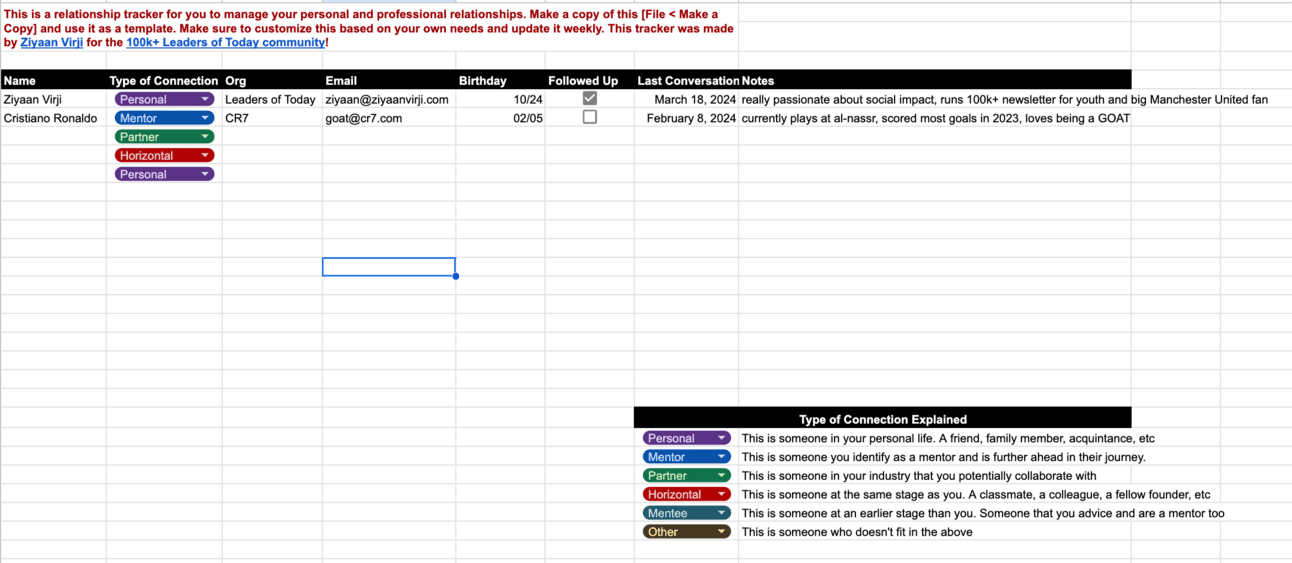
Each row has a name, their organisation, their email, their birthday, whether I've followed up, the date we last spoke, and personal notes. I also tag the type of connection: personal, mentor, partner, horizontal (someone at the same stage as me), mentee, or other.
After meeting someone I try to add them as soon as possible. I'm not as consistent with it as I'd like to be, but even an imperfect version helps.
If you want it, here is the relationship tracker template. Make a copy and change it to fit how you work.
Step 3: Engage on social platforms
This is the easiest way to keep multiple touch points with someone.
Depending on the relationship and how present they are online, pick the platform that makes sense. LinkedIn is usually a safe bet, and engaging with their posts costs you almost nothing.
"But what if they don't post much?"
A rarely-discussed option is to write them a LinkedIn recommendation. It's an easy way to stand out and to deepen the relationship at the same time. Here's the one I wrote for Zabeen after we met.
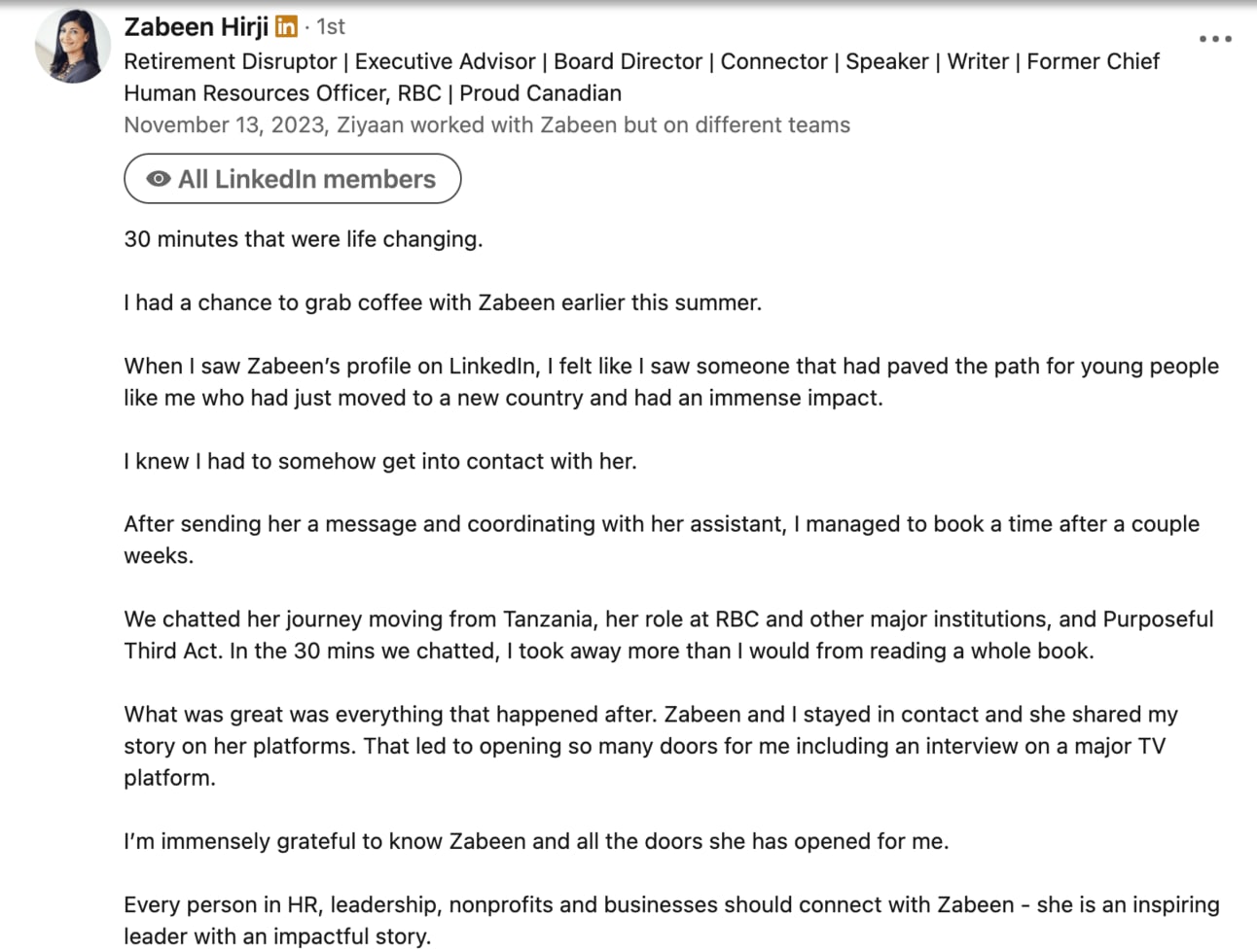
Notice how specific it is. It tells the story of the actual conversation rather than listing adjectives, which is what makes it worth reading.
If you have less time, endorsing someone for their skills takes seconds.
Step 4: Update them regularly
Anyone can do steps one through three. Most people fall off here, myself included.
This is where relationship management actually comes to life. Try to send your connections an update at least once a month.
Regular updates let them see your progress since the conversation, which means you're top of mind whenever an opportunity comes up. It also shows that you still think about them as you grow.
Some prompts for those updates:
- How did you take action from our last chat?
- What is something you're most proud of?
- What challenges are you currently facing?
- What is your goal for the coming month?
- How could they best support you in reaching it?
If your list gets long, you can send one monthly update to a group of people at once rather than writing each one individually.
Step 5: Reach out on special occasions
Birthdays, New Year, holidays, and other occasions are natural touch points. They build depth, and they're a good way to revive a connection you haven't spoken to in a while.
Here's an example. It had been a while since I'd connected with Nadia Ladak, co-founder and CEO of Marlow, and International Women's Day was coming up. I used the day as a reason to send her a note and tell her what I was grateful for.
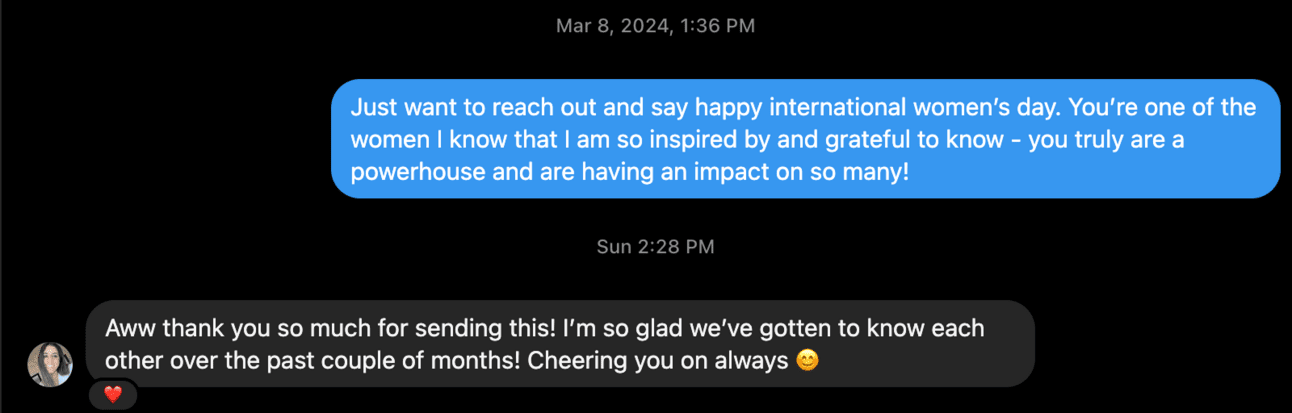
It was two sentences. Things like that go a long way.
The five steps, in short
- Follow up within 24 to 48 hours.
- Add them to your relationship tracker.
- Engage on social platforms.
- Update them monthly.
- Reach out on special occasions.
This list isn't exhaustive. It's the version I arrived at after getting it wrong for years, and it's enough to turn a good conversation into a relationship that still exists a year later.
Frequently asked questions
- How soon should you follow up after a coffee chat?
- Within 24 to 48 hours. Most people either skip this or send a generic thank you note, so a specific, useful message right after the conversation already puts you ahead.
- What should a coffee chat follow-up email say?
- Keep the subject line simple. Thank them, reference one specific thing from the conversation, add something genuinely useful such as an article or podcast tied to what they said they care about, and make no ask.
- Should you ask for a referral in a follow-up email?
- Not in the first one. Build the relationship before you need something from it. If someone has followed your work for months, the referral conversation happens naturally and often without a formal application at all.
- How do you keep track of everyone you meet?
- Use a simple tracker rather than treating LinkedIn connections as a system. I use a Google Sheet with the person's name, organisation, birthday, the type of connection, the date we last spoke, and personal notes.
- How often should you stay in touch with a new connection?
- Aim for a short update about once a month, plus a note on birthdays, New Year, and holidays. Monthly updates keep you top of mind whenever an opportunity comes up.